![]() |
![]() |
||||||
|
LA
CAMARGUE
: a crossroad for pilgrims and tourists!
|
|
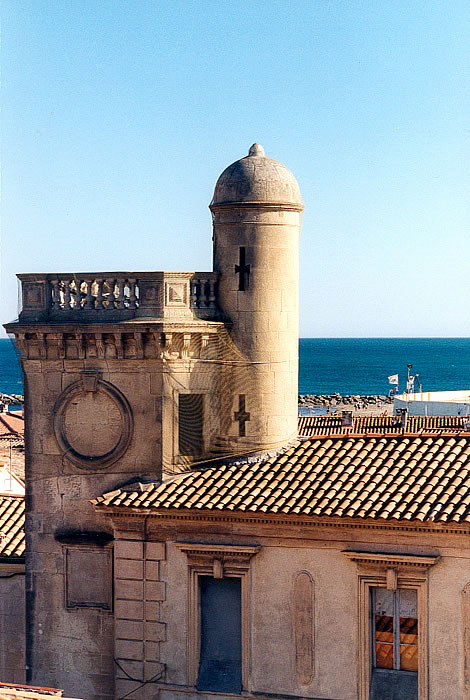
What we know of the lives of the hardy people who have led a meagre existence on this inhospitable marshland suggests hardship, and economic fragility. Dating from Roman times, traces in the form of coins, pottery stone fragments etc testify to the presence of trade, and the means and necessity to defend them. Watch towers and their remains remain as testimony. The Camargue at the mouth of a great river was a crossroads of visitors, peaceful and predatory. Forest covered considerable areas until the Middle Ages, providing wood for the shipyards of Arles. Wheat was cultivated by the Gallo-Romans, and the land around the three great abbeys of Psalmody, Ulmet, and Sylvestre, was cleared for agriculture.
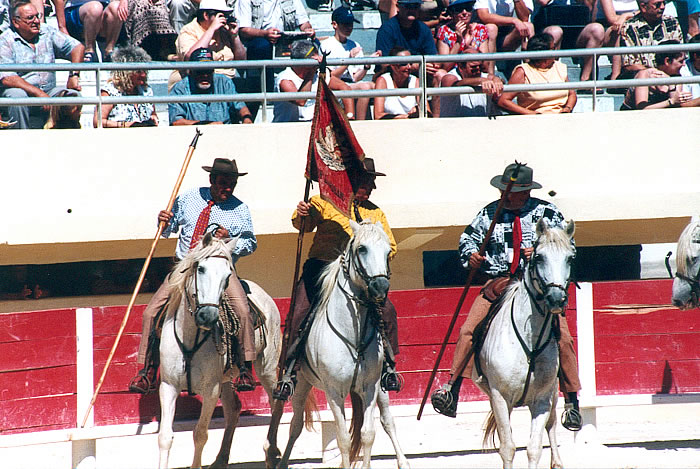
The "Dark Ages" of the Camargue drew to an end in the 17th and 18th centuries as feudalism retreated and science and economic and technical enlightenment advanced. The Rhône tamed and contained by dikes, land was reclaimed, and agriculture itself entered a new era. Vast tracts of land were purchased on which "mas" (large country houses) and "châteaux" were built and paved the way for todays manades, the manadiers (ranch owners), and their ranch hands "gardians", now the proud horsemen and cow-herdsmen who tend todays livestock and act as a source of live support for the regions folklore.
Our
vision of the Camargue, natural and historic, factual and fictional, past
and present, is varied enough to attract naturalist, scientist, sociologist
and
tourist; its abundance of salt grasses, rushes, and flowers,
its four hundred species of wildlife, badger, otter, beaver, heron, flamingos,
egret, wild duck, snipe, teal, curlew beckon on the one hand while, on
the other and in another register, "tucked in the bottom right-hand
corner" of the delta, the salt works and industrial blight stretch
from Port Saint Louis to Fos and beyond, jolting us back
into the grim reality of the parallel world that is "too much with
us" and which we came to escape. One remarkable man is largely responsible
for saving
"inventing"
the Camargue we have come
to discover. Directly and indirectly he has been the "Saint Sauveur"
(Holy Saviour) who arrived in the nineteenth century and whose life was
devoted to a "pays", its spirit, and its future.
|
||||||||
|
|
|
|
|