















|
|
|
|
|
||
|
|
|
|
|
||
|
|
|
||||
|
|
|
||||
|
|
|
||||
|
|
|
|
|||||
 It
was predictable that the Romans would choose to settle, first a camp,
later a colony, around the springs flowing below the Salluvian oppidum
into the valley of the Arc. Summoned for protection in 123 B.C. by the
Greek traders of Marseille they stormed the Celto-Ligurian stronghold
we call Entremont, massacred its inhabitants, and destroyed it. It
was predictable that the Romans would choose to settle, first a camp,
later a colony, around the springs flowing below the Salluvian oppidum
into the valley of the Arc. Summoned for protection in 123 B.C. by the
Greek traders of Marseille they stormed the Celto-Ligurian stronghold
we call Entremont, massacred its inhabitants, and destroyed it. |
|||||
 |
Ironically,
its ramparts still stand with their excavated houses, temple, and streets,
whereas the vestiges of the Roman camp and city established below now
lie mostly buried beneath the accumulated rubble and "improvements"
generated by their successors. Similarly, there is more Salluvian (Salyen)
to
admire in Aix’s Granet museum than there is of Rome’s might.
|
||||
| In
compensation, perhaps, the name of the Roman proconsul, Caius Sextius
Calvinus lives on in modern Aix, a broad thoroughfare, the Cours Sextius,
a university residence, a hairdresser, and a business in garment alteration
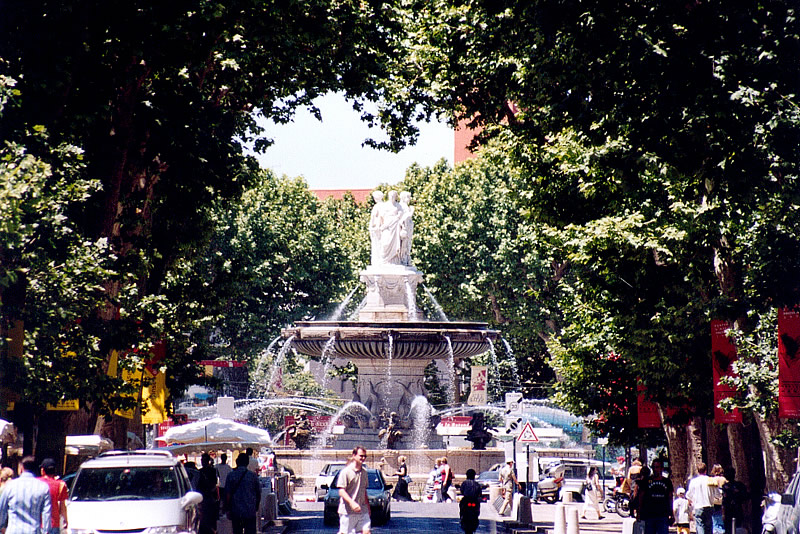
bear his proud name. This same civic memory pays homage to the fifteenth century king René, the poet Malherbe, the revolutionary Mirabeau, the painter Cézanne, and a company of "grands hommes" whose association with Aix is less than intimate and whose notoriety has lost much of its former lustre. Roman
Aix, the colony, that is, lasted for about three hundred years, from 15 B.C.
to about 275 A.D. By all acounts Aquae Sextiae was a splendid "spa" rivaling
celebrated Baïes, near Naples. Warm thermal water still flows through the
moss-backed “fontaine d’eau chaude” in the middle of the Cours
Mirabeau, and, after a period of remission, Aix’s vocation as a watering
place is being relaunched. Its “Thermes” ressuscitated on the original
site of the Roman baths surge with imperial morgue dwarfing, and absorbing, an
elegant 18th century Hôtel des Thermes, and, for better or for worse, transforming
Aix’s most venerable raison d’être. |
|||||
|
|||||
| Rome’s
decline in the 3rd century A.D., the invasion of Frankish and Alamanic
tribes, and the insecurity that ensued was only partially redeemed
by Aix’s promotion to "archbishopric of the second Narbonnaise,"
an ecclesiastical and administrative area stretching from Fréjus
on the Mediterranean coast to Gap in the Alps of Haute Provence. The
archbishops of Aix-en-Provence and of Arles, capital of the neighbouring
métropole
(archibishopric) thus became "defensor civitatis" against
the invading Wisigoths. In 574 A.D. Aix-en-Provence, occupied once
more, by the Lombards
this time, pays ransom for its freedom, its proud Roman monuments :
forum, temples, amphitheatre and its public and private buildings are
pillaged,
their columns and stone being quarried for re-use by succeeding generations.
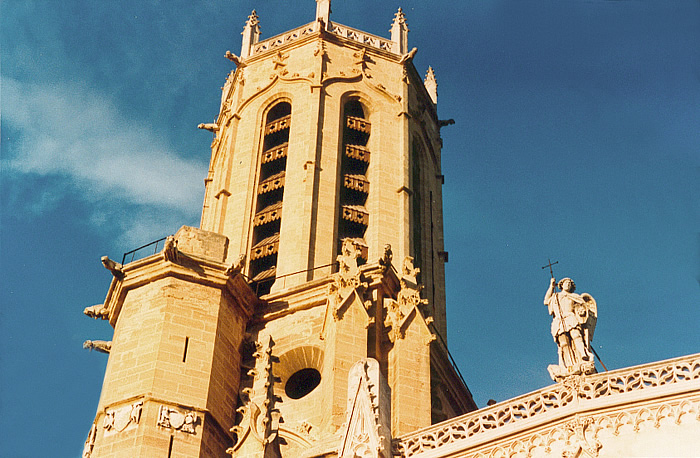
Some may be found to this day in the cathedral, in the walls of houses,
and in town squares where Roman columns have been resurrected in deference
to their elegant imperial origin. |
|||||
|
|||||
|
Aix-en-Provence |
Practical info |
Kiosk |
Entertainment |
Art Gallery
Learning | Maps | Camargue | Short cut | Homepage | Post-box |
Copyright © Provence Live 2011