|
|
|
|
| |
| History of Aix-en-Provence, a stroll through time |
|
|
|
| |
 The
site of the counts’ palace and the commerce that their presence
generated, gave rise to what is known as the "ville des comtes".
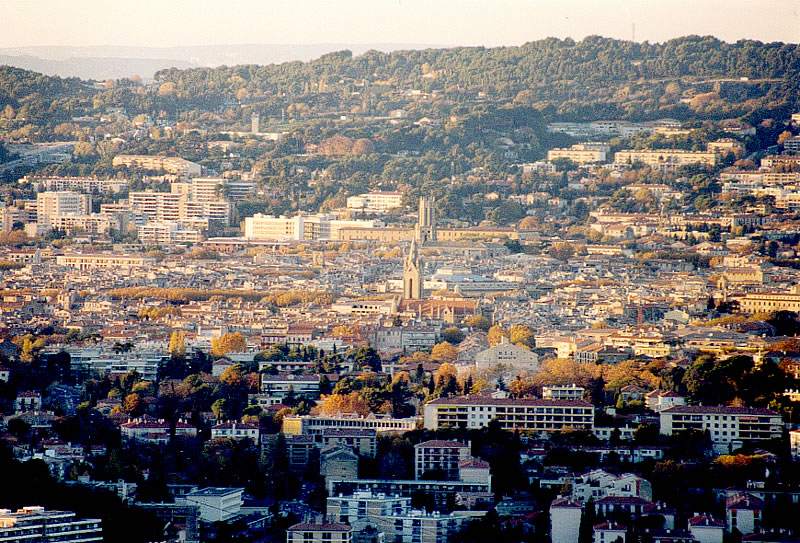
It includes most of the area between the belfrey tower adjoining the
city
hall and the Cours Mirabeau to the south. The reign of the counts was
not all peaceful or even happy. The black plague, the hundred years’ war,
and the intrusion of armed bands of "rouitiers", crusaders
on the loose, precluded peace and plenty. One figure among this bellicose
company stands out, his fame surpassing that of Aix’s most distinguished
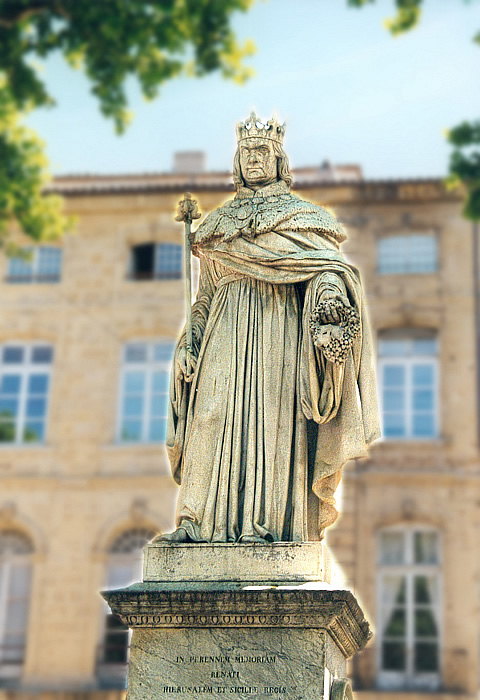
citizens. His statue stands at the east end of the Cours Mirabeau,
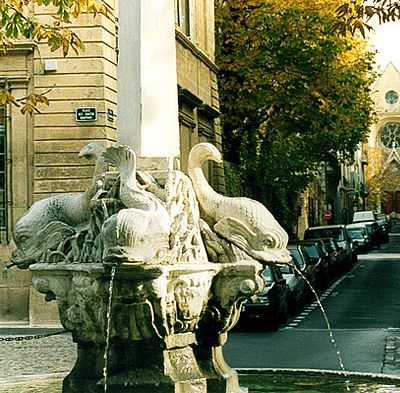
like a high priest gazing beyond his flock toward the baptismal font
spouting
to the west. The
site of the counts’ palace and the commerce that their presence
generated, gave rise to what is known as the "ville des comtes".
It includes most of the area between the belfrey tower adjoining the
city
hall and the Cours Mirabeau to the south. The reign of the counts was
not all peaceful or even happy. The black plague, the hundred years’ war,
and the intrusion of armed bands of "rouitiers", crusaders
on the loose, precluded peace and plenty. One figure among this bellicose
company stands out, his fame surpassing that of Aix’s most distinguished
citizens. His statue stands at the east end of the Cours Mirabeau,
like a high priest gazing beyond his flock toward the baptismal font
spouting
to the west.
René d’Anjou (1434 - 1480), king of Jerusalem, king
of Naples and Sicily, duke of Lorraine, the summum bonus in local
lore, the penultimate "count" to reign in Provence is credited
with great virtue and noble character. His reputation as poet, artist,
musician, patron of the arts,of agriculture and the courts of love, importer
of the muscat grape into Provence, does him more than justice. The sour
judgement of a recent historian refers to him as "in reality, a
deplorable, wily individual onto whom the Provençal populace projected
a generous hearted bonhomie". |
|
|
| |
In
1482 Provence was united to France, according to the proclamation as
"equal to equal", pious words hardly borne out by subsequent
history, the benefits of "union" being a generous portion
of the political and religious conflicts that marked the sixteenth
century. Noteworthy
among the buildings of this epoch is the hospital dedicated to Saint
Jacques. Founded and endowed by Jacques de la Roque. Refreshingly,
in a vein more reminiscent of the eighteenth century or even of the
twentieth, de la Roque’s deed stipulates that "shall be admitted
any man who suffers, whatever his beliefs, etiam diabolus (even the
devil)". He continues in similar truculent terms, shall
be refused admittance to the administration of the hospital any ecclesistic,
whatever rank he may hold in the church, etiam papa. (even, the Pope.) |
| |
 |
|
The
prodigious urban development that characterised Aix in
the seventeeth and eighteenth centuries, including the
Cours Mirabeau, the "Quartier Mazarin" and
the two suburbs to the southeast and southwest of the
"ville des comtes" account for much of what
one sees in Aix today. The king and his Intendants, governors,
and
churchmen,
at last brought order to the fierce opposition born of
centuries of Provence’s independence. Michel Mazarin,
brother to the Cardinal and archbishop of Aix, must be
credited with the most ambitious remodeling of the city
since Roman times. The "faubourgs" to the southeast
and southwest of the City of the Counts, the cours (later
Cours Mirabeau), and many splendid town mansions sprinkled
among less dignified dwellings in the bourg Saint Sauveur
and the ville des comtes, testify to a prosperity and
ambition whose scale and conception transformed the social,
economic,
and aesthetic equilibrium of "good king René’s
city". |
|
|
| |
The
prosperity of the eighteenth century was followed by the long Rip van
Winkle sleep of the nineteenth. The French revolution had done its
work. From "capital" of a region Aix was demoted to the humiliating
obscurity of a "sous-préfecture". As usual,
Aix-en-Provence had played its political cards badly, and the new "préfet"
Delacroix, named in 1791, found it "un village froid et orgueilleux"
; he decided that the future lay with Marseille. Incidentally, the
law
of the "28 plûviose" had decreed that prefects’ emoluments
must be based on the number of inhabitants in their circumscription.
"Honni soit qui mal y pense".
The nineteenth century passed Aix by, the railway from Paris to Marseille
was routed through Avignon, Arles, and Miramas, and once proud Aix dawdled
its daydream country market town existence into the twentieth century.
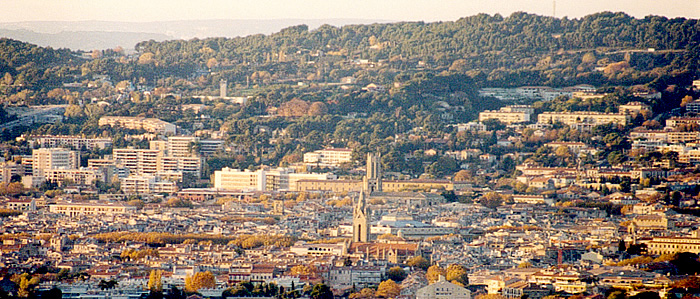
Thus was saved from the ravages of a builder such as Baron Haussman,
a swath of history and beauty that the twentieth century has not yet
succeeded in destroying. Much superb countryside has surrendered, many
highways and bypasses, new suburbs and box architecture have encroached
upon its ramparts. The march of the twentieth century continues inexorably,
with traffic clogging narrow streets, and the clamor of commerce, tourists,
students, and, yes, a few "true Aixois" who rub shoulders,
often ruefully, with a millennium as unpredictable and diffuse as the
Roman era was vigorous, single minded, and ruthless. |
| |
 |
| |
|
| |
|
|
| |