















|
|
|
|
|
||
|
|
|
|
|
||
|
|
|
||||
|
|
|
||||
|
|
|
||||
|
|
|
|
|||
Looking for Cézanne |
|||
|
|||
Though
"his" railway
viaduct now spans an autoroute as well as the valley of the Arc, green
pastures still lurk among the tangled geometry of invasive concrete
"cubism". Few
baigneuses, big or small, naked or clad, sport by the Arc, though the
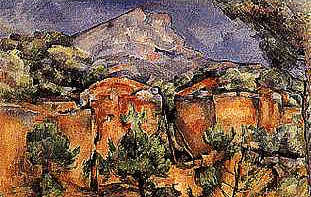
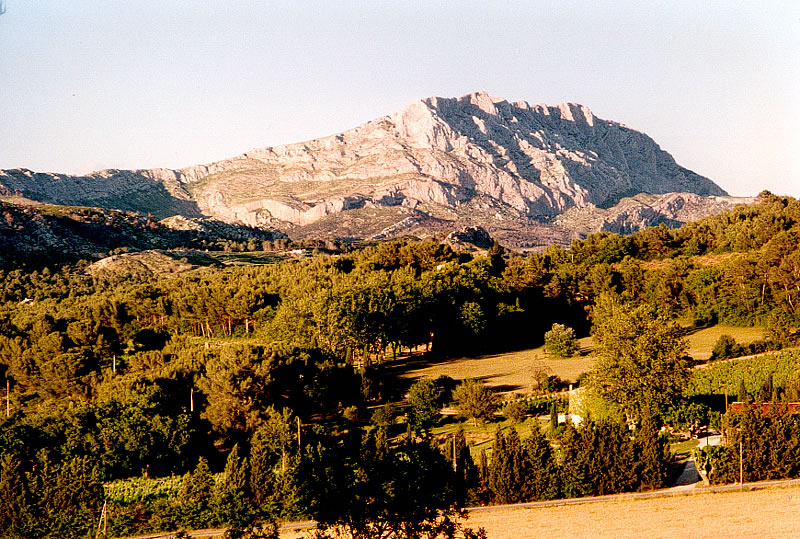
landscape is still unmistakeably Cézanne’s... the mountain
still stands guard, and "the world" is beginning to talk. "When
one is born there, tout est foutu", so wrote Cézanne
from Talloires to his good friend Philippe Solari. It was the land
that
he loved; social integration was another matter. |
|||
|
|||
What
Cézanne would make of the "utilitarian unconscious" of
the twentieth century is best left to the imagination. Somewhere,
half way between the imposing tomb which contains Picasso’s
remains in the park of the château de Vauvenargues, and the
family vault that houses Cézanne’s on the other side
of the mountain, rises the long crest of the massif de la Sainte-Victoire.
We may imagine, to the north, the protean spirit of the twentieth
century, universal zeitgeist, mirror, crystal ball, catalyst
and illusionist, whose prolific inventiveness remains a perpetual
challenge. On the other side, Cézanne’s grave, the universality
of a single human spirit struggling with the soul that he, like the
dog, has sniffed all his life, and which lies, not in a "utilitarian
unconscious", but in the depth of "human being and
being human". Its highest expression transcends time and
history ; it is an ecstasy forged in the encounter between the eye
of the
artist
and nature. All else is vanity. If, in the year 2000 visitors still
flock to Aix-en-Provence, it is, perhaps, because Cézanne
has transmitted a message which is reassuring, accessible to all.
"The world" has sniffed it out, and needs it. |
|||
PS : On
August 28, 1989, the Mont Sainte-Victoire caught fire. Newspapers
blamed the Mistral wind, and the sparks from a treedozer. Others
speculate
that Cézanne and Picasso were engaged in heated discussion. |
|||
|
Aix-en-Provence |
Practical info |
Kiosk |
Entertainment |
Art Gallery
Learning | Maps | Camargue | Short cut | Homepage | Post-box |
Copyright © Provence Live 2011

 In
a celebrated letter Cézanne speaks of the magic moment
when "the
canvas clasps its hands" as in prayer. Religion, whether
defined as a "binding together", or as a "re-reading" brings
Cézanne closer to Rousseau and the romantics than to the
century that his painting ushered in. Underlying it is passionate
faith, humility, and an uncompromising commitment to man’s
relationship to the beauty and grandeur of God’s creation.
It is hardly surprising that such esoteric preoccupations should
fail to sit well with the prevailing bourgeois spirit of a small
market town living on the memory of its past.
In
a celebrated letter Cézanne speaks of the magic moment
when "the
canvas clasps its hands" as in prayer. Religion, whether
defined as a "binding together", or as a "re-reading" brings
Cézanne closer to Rousseau and the romantics than to the
century that his painting ushered in. Underlying it is passionate
faith, humility, and an uncompromising commitment to man’s
relationship to the beauty and grandeur of God’s creation.
It is hardly surprising that such esoteric preoccupations should
fail to sit well with the prevailing bourgeois spirit of a small
market town living on the memory of its past.